A deterministic PDE simulator that realizes sub-limit dynamics in a continuous domain. The system evolves on a 220×220 toroidal grid under four operators—each mapping to a structural component of the CGS framework. No stochastic terms, no fitting, no free parameters beyond the operator coefficients.
The Ω-field is not a model of a specific physical system. It is a scientific instrument: a controlled environment where the structural predictions of the framework can be tested, falsified, and measured with arbitrary precision.
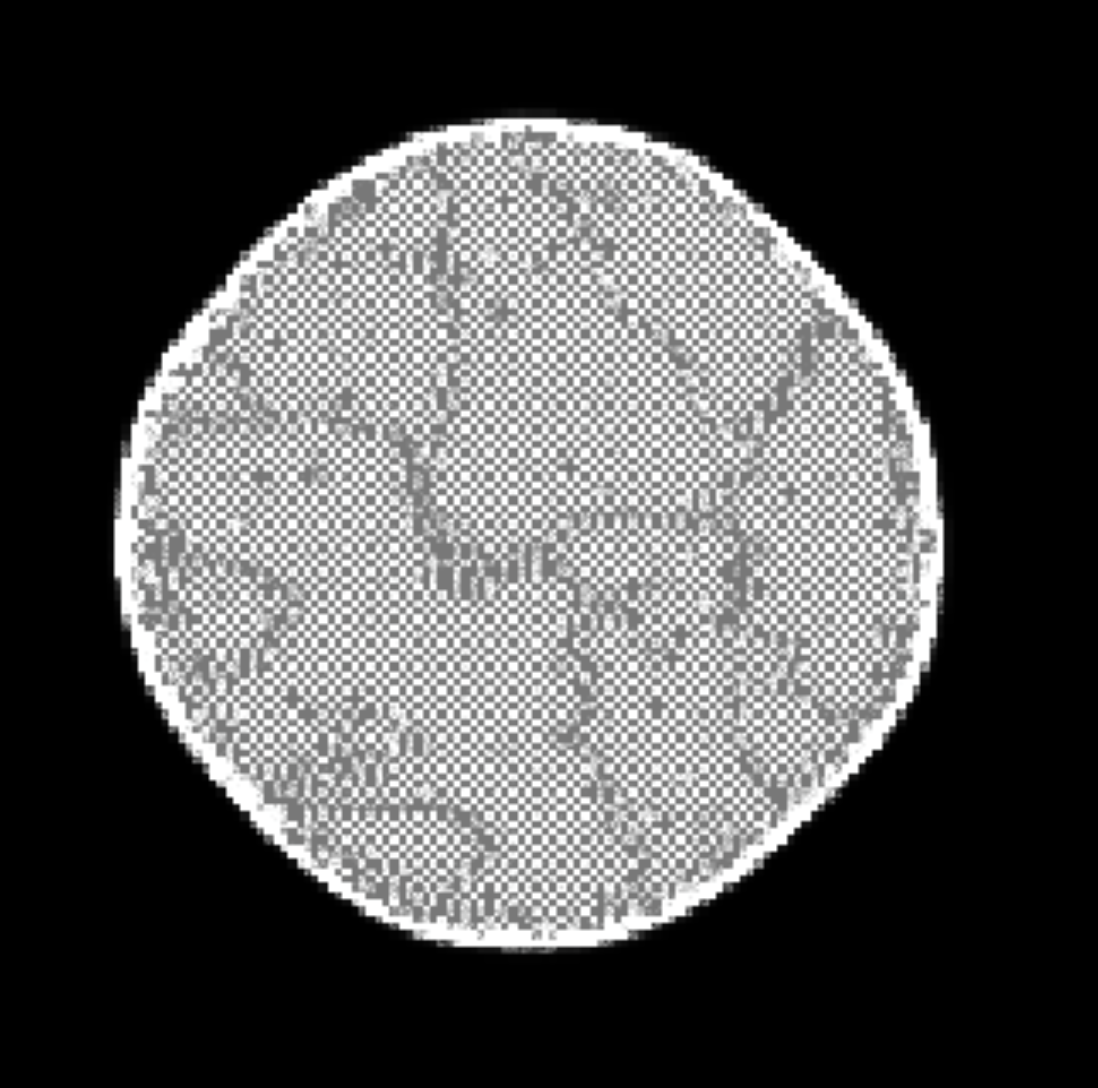
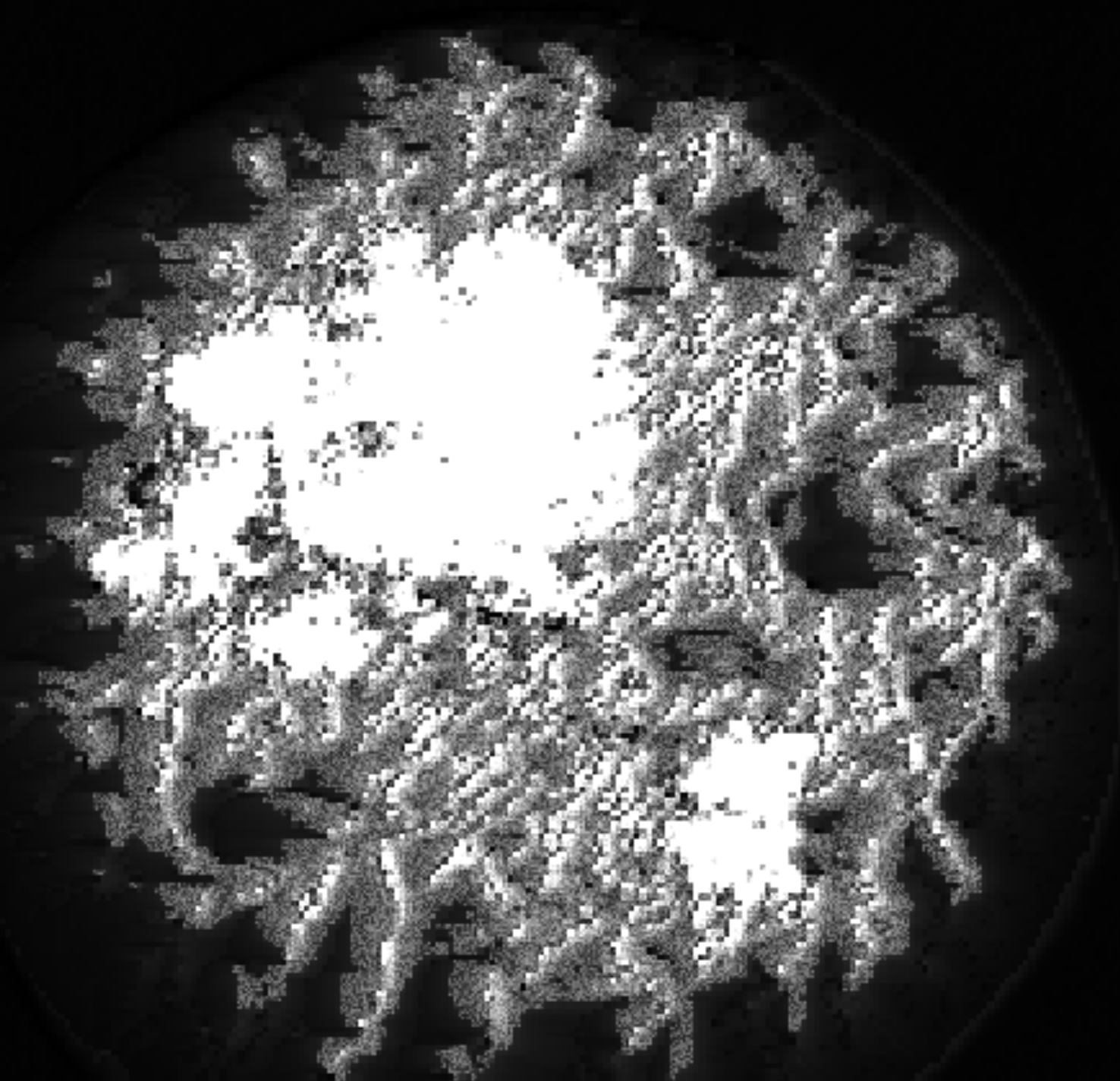
The period of the limit cycle is an exact function of the tangential rotation operator alone. This is not a fit—it is a structural law that emerged from the simulation and was subsequently verified across the full parameter range.
Systematic parameter sweeps have identified five distinct asymptotic behaviors, each corresponding to a region of the (σ, ω, smooth) parameter space:
T ≈ 390 steps. Van der Pol relaxation type (not Hopf). 48,400-cell dynamics reduce to a 2D effective manifold. Cycle robust under perturbation.
The simulator independently reproduced circular mass morphology, necrotic core, proliferative rim, and Q35 topological selection—without being calibrated on biological data. First experimental data point for C8.
Fragmentation (Q35), saturated oscillation (Q23–Q24, border = N²), and compressive collapse (Q36). Each corresponds to a distinct regime in the CGS classification.
Unlike discrete agent systems, the continuous PDE system shows no phase transition at critical λ values. This confirms that the phase transition is a property of discreteness, not of the constraint structure itself. A structurally important finding.
The Ω-field simulator exists as a browser-based instrument (3,461-line JavaScript) and a server-side physics engine (PHP CORE v0.1, 84/84 tests passed). The public interactive version is under development.
Current work: JS↔PHP determinism verification, dynamic parameter protocols via L(t) schedules, fine bifurcation sweep ω ∈ [1.0, 2.0], and the Ω-field paper using experimental data from the CORE runners.
Work in ProgressThe Ω-field derives from C3 (the three axioms realized as a continuous PDE), provides experimental data for C8 (cross-domain demonstration), and is the basis for a planned patent on the Ω-field as a diagnostic and predictive tool.
The four operators map directly to the CGS structural components: σ (radial compression) and ω (tangential rotation) are the two spiral phases; smooth is diffusive transport; damping enforces irreversible consumption.